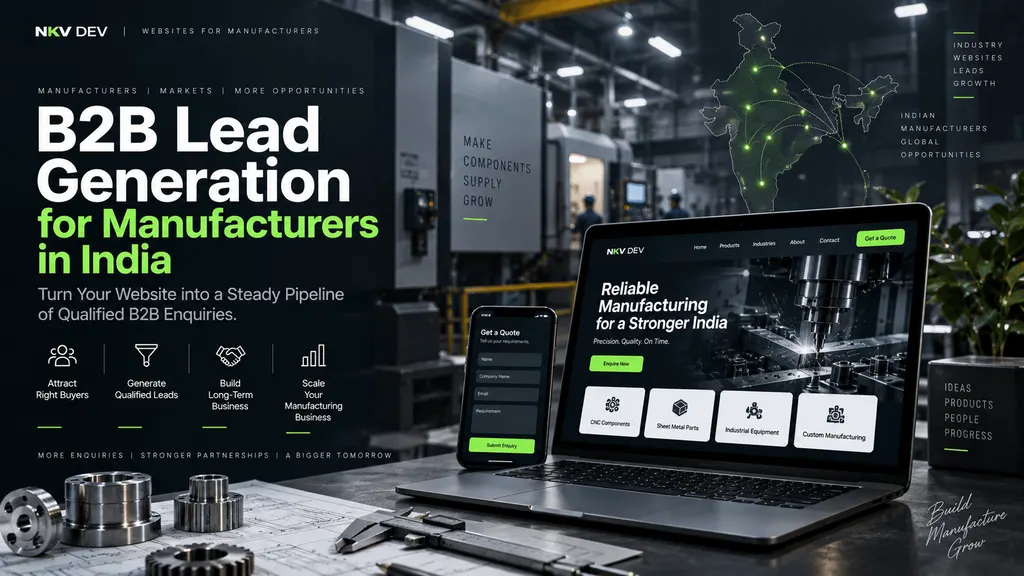
B2B lead generation for manufacturers in India works when it produces qualified RFQs, not enquiries: a buyer with a defined requirement, a budget, a timeline, and authority to place an order. The channels that produce them are Google search, LinkedIn, your own website, IndiaMART, trade fairs, and distributor networks, used together rather than as alternatives. Most manufacturers get this wrong in one specific way, which is treating IndiaMART as the whole strategy and their website as a visiting card.
The arithmetic explains why. IndiaMART’s Q4 FY26 results reported roughly 27 million unique business enquiries and about 8.7 million supplier storefronts, and a 2026 benchmark analysis of the platform put enquiry-to-payment conversion at around 2.3%. A marketplace puts you in a queue beside every competitor with similar specifications. On a marketplace, a buyer is always one tab away from your cheapest rival.
Your own website inverts that. There is no competitor listed beside you, and the buyer is researching on your ground. But it only works if the site is built to receive an enquiry rather than to describe a company.
Why IndiaMART and trade fairs are not enough anymore
They are not enough because the buying decision now happens before the enquiry, not after it. 6sense surveyed more than 900 B2B buyers and found first contact with a seller landing around 70 per cent of the way through a purchase that averaged 11 months, with the buyer opening the conversation themselves 83 per cent of the time (6sense buyer research).
That has a blunt consequence. When a manufacturer’s enquiry first appears, the shortlist is often already formed. A marketplace listing competes on price and response time at the very end of a process you were not present for. A website lets you be present during the research, which is where the decision actually gets made.
The second reason is follow-up. B2B agency DESENO, whose author Akash Garg writes about manufacturing pipelines, describes the pattern directly: spending on more lead generation while RFQs rot in a follow-up gap is “the most common, most expensive mistake manufacturers make”, because the money is spent filling a bucket that is never plugged. Buying more enquiries into a pipeline with no follow-up discipline produces a rising cost per order and the false conclusion that lead generation does not work for manufacturers.
Trade fairs still matter, and this is not an argument against them. A fair compresses a year of relationship building into three days. What it does not do is stay open at 11 p.m. when a procurement engineer in Coimbatore is comparing three suppliers. Fairs create relationships. Websites capture demand between them.
The channel mix that brings qualified RFQs
Manufacturers who consistently get qualified enquiries run four or five channels at once, each doing a different job.
Google search is where most of it starts, provided you rank for the terms buyers actually type. Not “manufacturer in India”, which is how competitors describe themselves, but the product, the material, the standard, the application. Someone searching a specific grade of stainless steel or a particular IEC-certified component is much further down the buying process than someone browsing a directory.
Your own website does the converting. Every other channel should point at a page built to capture an RFQ, and a product or application page that answers a technical question and offers a datasheet will out-convert a homepage every time.
LinkedIn suits named accounts. Procurement heads, plant managers and purchase engineers can be found there by role and company, which makes it account-based prospecting rather than broadcasting.
IndiaMART and similar marketplaces bring reach, so keep them as top-of-funnel volume and improve the listing quality. The platform’s own management says deeper product specification is what raises enquiry quality.
Trade fairs still work, on one condition: the contact list gets used inside the week. An email linking to the exact product page discussed at the stall moves the conversation onto your own site, where the rest of the decision will happen.
The failure mode is running one channel in isolation and concluding the channel does not suit manufacturers.
How to build an RFQ-ready landing page
Need a website built properly?
Fast, modern, fully owned — from ₹7,999, delivered in 1–2 weeks.
Chat on WhatsAppSee pricingAn RFQ-ready page does one thing: it moves a researching buyer into a structured enquiry with as little friction as possible. Everything else is decoration.
Put the specification table above the fold. B2B buyers in manufacturing are looking for dimensions, materials, grades, tolerances, capacity, and certifications. Product photography is useful; a specification table is decisive. If a buyer has to scroll past a brand story to reach the numbers, you have lost them.
Offer a datasheet download. A PDF datasheet serves two purposes: it gives a technical buyer something to circulate internally, and it gives you an email address. A gated datasheet converts research into a named contact without demanding a long form.
Make the enquiry form RFQ-shaped, not contact-shaped. Ask for the product or grade, quantity or MOQ, application, delivery location, and timeline. A field labelled “Message” gets one-line enquiries. A field labelled “Quantity required per month” gets procurement enquiries.
Put WhatsApp and a phone number where they are visible immediately. Indian B2B buying still runs on a phone call, and a click-to-chat link removes the friction of composing an email. This is the single highest-impact change on most manufacturer websites, and it costs nothing.
Publish certifications, test reports, and client references. A buyer shortlisting suppliers is assessing risk. ISO certification, a test report, an export licence, and a couple of named clients remove more doubt than any amount of marketing copy.
Give each product or application its own page. One page per product family, with the specification table, the datasheet, the applications, and its own RFQ prompt, is what lets search traffic land somewhere relevant instead of on a homepage.
How to qualify a manufacturing lead before it wastes sales time
Most manufacturers do not have a lead volume problem. They have a lead quality problem, and the cost is sales time spent on enquiries that were never going to convert.
Qualify on five things at the point of enquiry, using form fields rather than a phone call.
- Is there a specified product, grade or specification? Vague enquiries cost the most time.
- Does the quantity clear your minimum order? A buyer wanting two units when your minimum is five hundred is a different conversation.
- What is it for? The application decides whether you can serve them at all, and it predicts whether the buyer is real better than any other field.
- What is the timeline? “Immediately”, “this quarter” and “just researching” need three different replies.
- Who are you talking to, and at which company? A decision influencer and a purchase clerk need different follow-up.
A form that captures these five fields gives you a prioritised queue. A form that captures name, email, and message gives you a pile. The difference shows up in the sales team’s week, not in a dashboard.
Why speed-to-lead decides most RFQs
Manufacturing is a considered purchase, so it is tempting to assume that speed does not matter. The opposite is true. Speed decides who is in the conversation, even when the final decision takes months.
Industry data on buyer behaviour puts the expectation for a first response at within four hours (Weboo, 2026), and in practice the first competent responder is often the one who receives the specification. A manufacturer who replies the next morning is frequently quoting against a document they did not help write.
The fix is procedural, not technological. Route every web enquiry and WhatsApp message to a named person, with a defined first-response window, and an alert that escalates if nobody replies. A shared mailbox with no owner is where RFQs go to die. Most Indian MSMEs can implement this in an afternoon without buying any software, and it will outperform a new lead channel for the next quarter.
The second half of speed-to-lead is follow-up cadence. A manufacturing sale rarely closes on the first quote. Buyers go quiet for weeks, then return when a budget clears or a current supplier disappoints. A written follow-up sequence, spaced over months rather than days, is what converts the enquiries that a one-off reply loses.
What changes for export enquiries
Export enquiries behave differently from domestic ones, and the differences are practical.
An enquiry from Germany arrives while you are asleep. A stated response window that you actually honour within twelve hours is a competitive advantage on its own.
Documentation comes before negotiation. Export buyers screen on certifications, test reports, packaging standards and compliance before they discuss price, so publishing those removes a filter that quietly eliminates most small suppliers.
Country pages beat a generic export page. One that names the target market, the standard it complies with and the logistics route tells the buyer you have served their market before. Naming your Incoterms, currency and payment terms saves a round of emails on top.
Export buyers are fewer, better researched and worth more per enquiry, which is the whole argument for giving them pages of their own rather than folding them into one export section.
How to measure B2B lead generation for manufacturers properly
Measure cost per qualified RFQ, not enquiry count. Enquiry count rewards channels that produce noise, and it is the number that makes manufacturers believe lead generation does not work.
Here is the arithmetic that matters. Suppose you spend ₹40,000 per month across a Google campaign, a content effort, and a marketplace subscription, and you receive 60 enquiries. If 30 are unqualified, 20 are qualified but not ready, and 10 are genuine RFQs, your cost per enquiry is ₹667 and your cost per qualified RFQ is ₹4,000. If those 10 RFQs produce two orders at ₹3,00,000 each, the channel is performing well at ₹20,000 of acquisition cost per order. If they produce zero, the channel is not the problem, and buying more enquiries will not fix it.
Track a simple four-stage funnel: enquiry, qualified RFQ, quotation sent, order. Anything not tracked cannot be improved, and most manufacturers have the first stage and nothing after it.
Two signals tell you the system is working before revenue shows it: a rising share of enquiries that name a specific product or specification, which means your product pages are being found during research, and a falling share of enquiries that ask what you make, which means your positioning is landing.
What to fix first, in order
Sequence matters, because each fix makes the next one cheaper, and one mistake sits behind most of the wasted budget: buying more leads into a broken follow-up process. That is the DESENO failure above, and the most expensive one. Fix the response window and the cadence before increasing spend.
Optimising for enquiries rather than qualification produces exactly the noise that makes manufacturers give up. A form with five qualifying fields returns fewer and better ones, which is the point.
Chasing search volume for the wrong terms brings competitors and job seekers. “Manufacturer in India” is a phrase other manufacturers search. A product plus its application is what a buyer searches.
Treating the website as finished wastes the compounding. A manufacturer publishing two technical pages a month ends a year with twenty-four entry points and a lead flow that no longer depends on advertising.
No shared record is the quiet one. If the enquiry lives in one salesperson’s inbox, the business does not own it, and a simple shared sheet beats an unused CRM every time.
For a structured, attributed example of what focused execution produces, agency EvoKast reports a manufacturing client generating 28 qualified distributor enquiries in 60 days, with 9 converted into active partners, and a 4x increase in inbound lead volume from target geographies within four months (EvoKast, 2026). A client quoted by B2B agency Andreal describes the change from the buyer’s side: “We moved beyond referrals and started getting real inbound enquiries from companies we had never spoken to before.” That shift, from depending on who already knows you to being found by buyers who do not, is the whole point of the exercise.
What to fix first, in order
Fix speed-to-lead first. It costs nothing, it applies to enquiries already arriving, and it improves conversion on every channel at once. If RFQs sit unanswered for a day, more traffic will not help.
Then make one page RFQ-ready. Pick your highest-margin product family and build a single page with a specification table, a gated datasheet, an RFQ-shaped form and a visible WhatsApp link. One good page tells you whether your buyers respond to structured content before you invest in twenty of them.
Third, qualify at the form. Add the five fields and watch the sales team’s week change, because this is the step that turns a rising enquiry count into a queue somebody can work through.
Invest in search and content fourth. Paid traffic only pays back once the first three steps work, because by then you are sending buyers into a system that converts them. Building traffic first is the classic waste, and it is why manufacturers conclude that digital marketing does not work in their industry.
Add channels last. LinkedIn for named accounts, better marketplace listings and export pages all perform better on top of a site that captures demand than alongside one that does not.
A manufacturer who does B2B lead generation for manufacturers in this order will spend less and see results sooner than one who buys the most visible channel first.
Next step
If you want B2B lead generation for manufacturers to produce RFQs rather than raw enquiries, start with the pages that receive them. Our industrial website design service builds the product, application, and RFQ pages that make search and LinkedIn traffic convert, and our guide to getting more leads from your website covers the conversion layer in detail.
If speed-to-lead is your weak point rather than traffic, begin there instead, because it is the cheapest fix available and it needs no budget. Pick the five qualifying fields, name one person who owns first response, and set a response window you can actually keep for a month. That alone often moves more enquiries into quotes than a new campaign would.
If you are starting from scratch, look at our pricing or send us your product list and we will tell you which of the two problems is actually costing you orders, and what to fix before spending on traffic. For the underlying site decisions, read industrial website design for manufacturers in India.
Tags
#B2B lead generation#manufacturing marketing#industrial SEO#RFQ#export leads