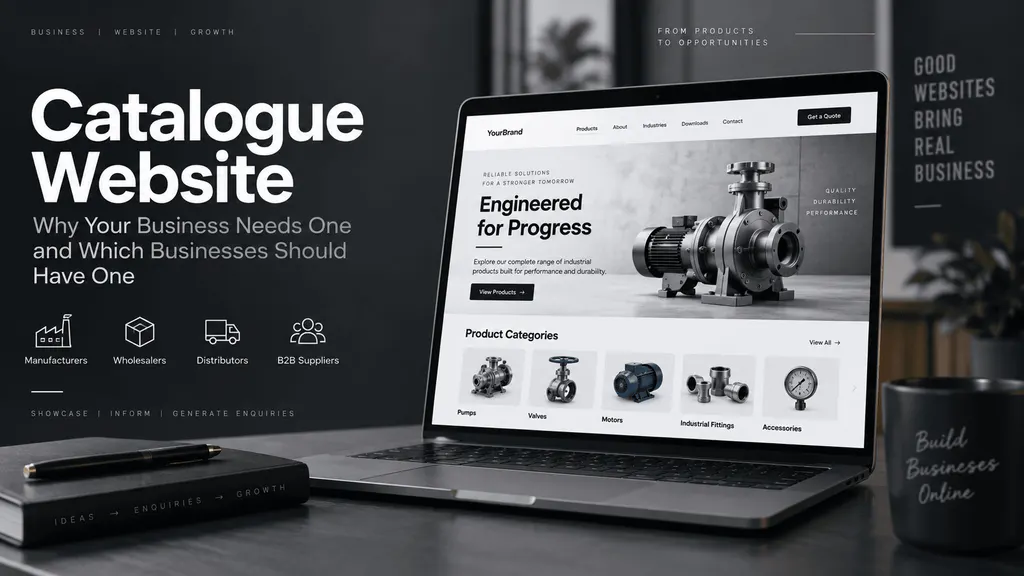
Not every business needs an online store.
If you are a manufacturer, wholesaler, distributor, supplier, or B2B company, your customers may not want to buy a product from your website at all. They want to see the products, read the specifications, compare a few options, and then talk to your sales team.
This is where a catalogue website earns its place.
A catalogue website is built to showcase a company’s products without letting customers buy them directly. Instead of behaving like an e-commerce store, it does the job of a digital product catalogue and sales tool.
What Is a Catalogue Website?
A catalogue website is where a business publishes its products, the images and specifications that go with them, and the technical detail a buyer needs before making a call.
A manufacturer might carry hundreds of lines, from industrial machines and automotive components to furniture, packaging and spare parts. Put the whole range on a well-organised website and a buyer in another state can browse it at eleven at night.
Pages carry categories, images, specifications, variants, datasheets and certifications, plus an enquiry form and a WhatsApp number.
The key difference is that the website focuses on showcasing products rather than completing an online transaction.
Why Is a Catalogue Website Important?
For a B2B company the website is often the first place a potential customer looks, long before anyone sends an email. A salesperson can carry a printed catalogue to one buyer at a time. A website answers every buyer who searches for you at once, including the ones your team has never heard of.
Your entire product range is available online
A printed catalogue goes out of date the day you print it, and the customer has to physically receive it before it does any work. A website carries the complete range and you can update it the moment a specification or a delivery time changes. Instead of emailing a heavy PDF, you send one link.
One website can act as your company’s catalogue 24/7.
Customers find your products on Google
A manufacturer of stainless steel industrial tanks wants to be found by the person typing “stainless steel industrial tank manufacturer” into Google. Properly structured product pages give it that chance. Instead of leaving discovery entirely to salespeople, the site brings buyers in on their own. Manufacturers and suppliers who sell to other businesses cannot rely on walk-ins the way a shop can.
It makes your business look more professional
Two manufacturers, same products. The first has a WhatsApp number, a phone full of photographs, and a PDF nobody can find. The second has a website with organised categories, specifications, certifications and an enquiry form.
Both may be equally reliable, but the second one looks like the safer supplier to deal with, and the site is how it got there. That is digital identity and credibility doing commercial work.
Which Businesses Need a Catalogue Website?
Need a website built properly?
Fast, modern, fully owned — from ₹7,999, delivered in 1–2 weeks.
Chat on WhatsAppSee pricingCatalogue websites suit businesses that carry multiple products but do not need online checkout.
1. Manufacturers
A manufacturer may run to thousands of products, models, sizes and configurations, and building a checkout for each one is pointless. A searchable online product catalogue lets customers browse, then ask for price, quantity, customisation, availability and delivery.
2. Wholesalers
An electrical wholesaler stocks switches, cables, LED lights and distribution boards. A catalogue website lets a retailer check what the wholesaler supplies, then send a “Request a Quote” or “Contact Sales” message instead of the wholesaler running a payment gateway for trade buyers who negotiate anyway.
3. Distributors
A distributor represents several brands and carries hundreds of items. Organising products by brand → category → product → specification is the difference between a customer finding the part and giving up on your site.
4. B2B suppliers
A B2B price depends on quantity, specification, delivery location and contract terms, so a fixed number on the page often does more harm than good. The catalogue shows the product and keeps the quoting conversation offline:
Industrial Pump Model X200 Capacity: 200 L/min · Material: Stainless Steel · Applications: Industrial / Chemical Request a Quote
5. Furniture manufacturers and suppliers
Furniture ranges are wide by nature, and buyers want to see finishes and dimensions before they discuss money. Customers browse the designs, then ask about pricing, customisation and delivery. For custom or bulk furniture that sequence is the whole sale.
6. Automotive parts businesses
Component makers and distributors can organise stock by vehicle, model, part number and application. That is how a workshop finds the right part instead of phoning three numbers to describe it.
7. Construction material suppliers
Tiles, sanitaryware, pipes and roofing go on a catalogue so contractors and architects can check the range before they call, which shortens the conversation once they do.
8. Textile and garment manufacturers
Fabric types, colours, patterns, collections and customisation options sit naturally on a website. For B2B buyers it works as a digital showroom rather than a shopping platform.
Catalogue Website vs E-Commerce Website
The usual objection is: “Why not just build a shop?” Because not every business sells products in the same way.
| Catalogue Website | E-Commerce Website |
|---|---|
| Showcases products | Sells products online |
| Usually no checkout | Has checkout |
| Customers submit enquiries | Customers place orders |
| Useful for B2B businesses | Useful for direct consumers |
| Prices can be hidden | Prices are usually displayed |
| Suitable for customised products | Suitable for standardised products |
| Sales team handles quotation | Website handles transaction |
A manufacturer selling customised industrial equipment gets very little from a checkout and a great deal from a catalogue.
What Should a Good Catalogue Website Include?
A pile of product photographs is not a catalogue. The site has to explain what the business offers and make contact easy.
- Product categories: products grouped so a buyer can drill from industrial equipment down to pumps or valves without guessing.
- Individual product pages: one page per important product, with images, description, specifications, variants, applications, related products and an enquiry button.
- Search: a business with hundreds of products needs product search, or customers page through dozens of listings hunting for one item.
- Product filters: material, size, capacity, brand and application are the filters that matter on a large catalogue.
- Enquiry form: where a shop says “Buy Now,” a B2B catalogue website uses “Request a Quote,” “Send Enquiry,” “Contact Sales,” or “Get Pricing.”
- WhatsApp and phone: Indian buyers still prefer a call or a message. Put the number where it can be tapped, not buried at the bottom of a contact page.
We build this pattern for clients. See Digital Catalog Websites and Industrial Websites for how the categories, product pages and RFQ workflows fit together.
A Catalogue Website Can Become a Sales Tool
The expensive mistake is treating a catalogue website as an online brochure. Built properly, it sits inside the sales process:
Google Search → Product Page → Customer Reads Specifications → Customer Views Other Products → Customer Sends Enquiry → Sales Team Contacts Customer → Quotation → Order
The website does not have to process the transaction. Its job is to bring the right customer to the right product and generate a qualified enquiry.
Who Doesn’t Necessarily Need a Catalogue Website?
A catalogue website is not automatically the right choice. A business with one or two services may only need a simple business website. A company selling standardised consumer products directly to customers will usually do better with an e-commerce store.
The question worth asking is “How do my customers actually buy from me?” If they need to see products first and then contact you for pricing, quantity, customisation or a quotation, a catalogue website fits.
Why Manufacturers Should Consider a Catalogue Website
For a manufacturer the site does several jobs at once. It shows the full range, brings in enquiries from search, gives the sales team a link to send instead of a PDF, and hosts the technical documents that distributors keep asking for. It works 24/7 and it belongs to you, which is what a permanent digital showroom means in practice.
When a Catalogue Site Beats a Shop
If your customers follow a process like find product → check details → ask for price → request quote → place order, rather than add to cart → pay → receive product, a catalogue website will serve you better than a store.
Customers research a company before they make an enquiry. A searchable, well-organised catalogue makes that research easy, which makes the enquiry more likely.
Ready to replace your old PDF catalogue with a website that sells around the clock? NKV DEV WORKS builds catalogue websites from ₹7,999 with full code ownership: no lock-in, no monthly hostage fees. Get a quote or see the starting prices.
Tags
#catalogue website#product catalogue website#catalogue website development#online product catalogue#digital product catalogue#B2B catalogue website#manufacturer website#manufacturer website design#manufacturer website development#website for manufacturers#website for wholesalers#website for distributors#B2B website development#product catalogue website development#business catalogue website#online catalogue for business